| 11.00-13.00 | Christine de Smedt, Les Ballets C de la B: "9x9 - Choreographic Game-structure - The Deleuzian Sex Game" | |||||||||||||||||
|
The basic strategy of this choreographic game is to introduce a choreographic complexity
through exceptionally simple means. On a representational level the structure activates a
transformation of the individual person/performer into a mass, mass understood as one body.br>
The game enables each participant to move in his/her personal way without predefined references
to conventions of dance. It instigates a choreographic mode that can be inhabited by a broad range
of bodies, functioning on their own terms. The participant will further more him/her self be responsible
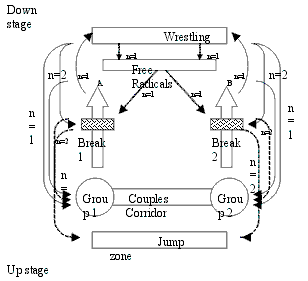
to flows and changes through making personal choices. Understood from the inside, as experience, the performer will be open to express his own physical desires, and from the outside, as performance, will create, on the one hand a concrete mass-organisation, and on the other introduce individuality, identity as continuous negotiation, between body, mind and environment. The game-structure can as well be comprehended as a critique of dance composition, and introduce an open-ended flow of possibilities for new formations. This perspective of flows, breaks and resistance can as well be understood as allegory for human interaction, an image of society. It, as well points to a difference between social dancing and concert dance. Through a defined set of rules (game) the performers can make open choices (play). There is further more no defined goal inscribed in the game but the intent is only to play or perform consciously. Group 1 and 2 Respond to oral instruction. A participant are alleged to execute each instruction, from up-stage to down-stage from position 1 or 2, but can decide not to. After each execution the participant are alleged to return to position 1 resp. 2 along the margins of the stage. A participant can execute any action without reference to instruction, then being alleged to stop and remain at position A respectively B, until another participant picks him/her up. When picked up both performers proceed to Wrestling. Wrestling-zone Participants can only enter Wrestling from Group 1 or 2-actions, executed through personal choice, and in company with a fellow participant. A participant can leave Wrestling via four modes. 1. In company with a fellow participant, both performers return to Group 1 or 2, and continue. 2. Through leaving in solitude but then to Break 1 or 2-position. 3. Through being the only subject in the zone. The participant then automatically becomes a Free Radical. 4. Through a personal consideration of being a good wrestler, then proceed to Free Radical. Free Radicals A participant can become a free radical via two modes (see above). When proceeding to free radical zone, the participant shall perform a personal dance solo, maximum 5 minutes in the confined area. A free radical can leave the zone at any given moment, given there are one or more participants in Break-zones that can be liberated, after which the free radical and the released participant in the break return to group 1 or 2. Break A participant can become a break only in response to leaving the Wrestling without a partner. The participant is alleged to stay in the break until he/she is released. The participant in the break can be released through: 1. When released by a free radical, both proceed to Group 1 or 2. 2. Through being released by a Group 1 or 2 member, whereas both participants proceed to Jump-zone. Jump-zone A participant can enter the Jump zone either through being a released participant in one of the break-zone, or through being a person in Group 1 or 2 that releases a participant in a break-zone. When such situations occurs both participants proceed directly to Jump-zone. The two participants will be released only when another couple enters the Jump-zone form the same direction, as the couple at hand. The maximum amount of participant in the jump zone is four. When released both participants proceed to Group 1 or 2, and continue the game. In the jump-zone the participant is alleged to jump up and down until being released. Couple-corridor The Couple-corridor functions as a trespass between Group 1 and 2. Any two participants can change side through travelling, as a couple. The travelling shall be performed through crawling. Movements
|
||||||||||||||||||